The Pay Transparency Law explained
The new European Pay Transparency Directive requires employers to be fully transparent about compensation, job evaluation and equal pay for equal work. The burden of proof shifts to the employer and non-compliance carries significant risks.
Last update: September 17, 2026 · Reading time: 8 minutes
What does the Pay Transparency Directive require?
This explanation follows the Dutch bill of 27 May 2026, not an act already in force. It defines pay level as gross pay. Definitions including base pay, gross pay and pay gap may be further specified in or under an order in council (AMvB). How reporting data is determined is also left to subordinate legislation. The bill therefore does not fully specify pay components, conversions and calculations.
- Transparent pay structures and job evaluation
- Equal pay for equal and equivalent work
- Objective, gender-neutral justification of compensation
- Reporting on pay differences
- Right to pay information for employees
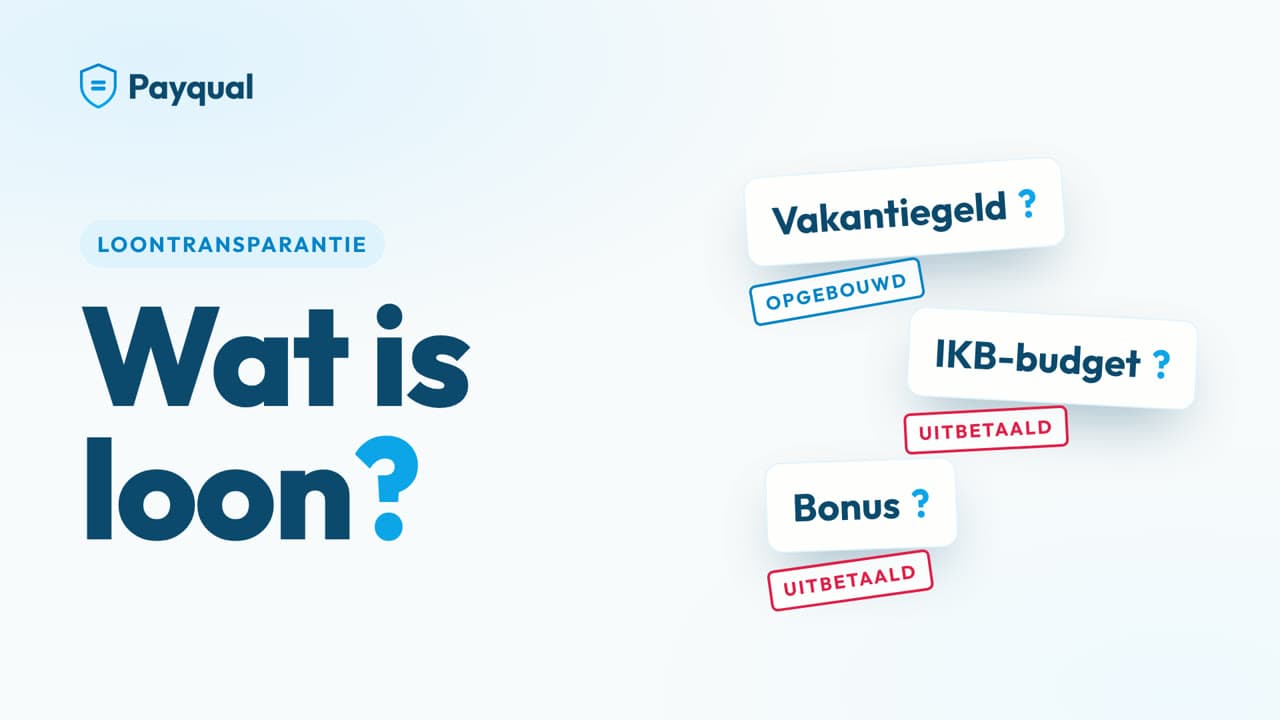
Video · 4 min
What counts as pay?
Does holiday pay count? What about an IKB budget or a bonus? See in four minutes which three pay amounts the law uses, and what for.
Watch the videoWhat does this concretely mean for your organisation?
The legislation translates into concrete obligations in your daily practice.
Objective and gender-neutral job classification
Jobs must be evaluated using objective, gender-neutral criteria: skills, effort, responsibilities and working conditions. Different roles can still be legally equivalent when the value of the work is comparable.
Read more
Gender pay gap report
Under the bill, organisations with 100 or more employees periodically report pay differences to the Minister of Social Affairs and Employment (SZW). The minister receives reports and publishes points a-f. This is separate from Labour Inspectorate supervision (Articles 10c and 10e Wgbmv).
Read more
Pay information request
Any employee can submit a written request to see their pay compared with the average in the same category, broken down by gender. Employers must provide a written response within two months. This applies to all employers, regardless of size.
Read more
Inform employees annually
Employers must inform employees annually that they have a right to pay information and how to submit a request (WGBMV article 10b paragraph 4).
Read more
Make pay criteria available
Pay criteria must be made available proactively so employees do not need to ask for them. For employers with 50+ employees, this also includes criteria for pay progression (WGBMV article 10a).
Read more
Pay gap by job category
The employer submits the report to the Minister of SZW and also shares point g, the pay gap per category, with its own employees (Article 10c(4) and (5) Wgbmv).
Read more
Recruitment information obligation
The starting salary or salary range must be shared before the first interview. Employers may not ask for current or previous salary, and job titles must be gender-neutral (WGBMV article 3 paragraphs 5-7).
Read more
Joint pay assessment (JPA)
Employers subject to reporting must carry out a joint pay assessment (JPA) if the report shows a pay gap of 5% or more within an employee category, there is no objective, gender-neutral justification and the gap is not remedied within six months of submission (Article 10d Wgbmv).
Read more
Handle clarification request
Employees may make a written, annual demand for insight into their own pay and the average pay by gender for equal or equivalent work. You have two months to respond; a missing or incomplete reply reverses the burden of proof (Directive 2023/970, article 7).
Read more
Each of these obligations carries its own legal and financial risks. We show you what they are and how to prevent them.
The risks are substantial
Non-compliance with the legislation carries significant legal and financial risks.
Reversal of burden of proof
As an employer, you must demonstrate that there is no discrimination. In case of doubt, the ruling is in favour of the employee.
Strict deadlines for pay disclosure
Failure to respond to information requests in time can lead to sanctions and strengthens the employee's position in disputes.
Mandatory Gender Pay Report & JPA
A pay gap of 5% or more within an employee category requires a joint pay assessment if there is no objective, gender-neutral justification and the gap is not remedied within six months of report submission. Six months is the remediation period, not the deadline for carrying out the assessment.
Publication of fines
Fines for non-compliance can be made public, resulting in reputational damage.
Risk of claims in job evaluation
Positions with different content can legally be considered equivalent, which can lead to unexpected claims.
Note: Positions with different content can legally be equivalent. A marketing manager and an IT manager can be considered comparable under the legislation.
The legally required process
Compliance requires a structured process. These five steps are essential.
Load
(Directive recital 44; WGBMV article 1)
What the law requires
Collect all compensation data and job information.
What Payqual does
Payqual connects to your HR system or securely processes your export.
Cluster
(WGBMV article 8; WGBMV article 7; Directive recital 26)
What the law requires
Group positions based on equivalent work.
What Payqual does
Automatic clustering based on objective criteria.
Detect
(WGBMV article 10c paragraph 1, 5-6; Directive recital 39)
What the law requires
Flag pay gaps of 5% or more between women and men per employee category. Detailed calculation rules follow in or under an order in council (AMvB).
What Payqual does
Real-time alerts for deviations that require attention.
Correct
(WGBMV article 10c paragraph 6; WGBMV article 10d; Directive recitals 43 and 51)
What the law requires
Justify or correct identified differences.
What Payqual does
Tools to record objective justifications.
Report
(WGBMV article 10b and 10c; Directive recitals 38–41)
What the law requires
Submit the pay report electronically to the Minister of SZW.
What Payqual does
Ready-made reports that meet all PTD requirements.
Load
What the law requires
Collect all compensation data and job information.
What Payqual does
Payqual connects to your HR system or securely processes your export.
Cluster
What the law requires
Group positions based on equivalent work.
What Payqual does
Automatic clustering based on objective criteria.
Detect
What the law requires
Flag pay gaps of 5% or more between women and men per employee category. Detailed calculation rules follow in or under an order in council (AMvB).
What Payqual does
Real-time alerts for deviations that require attention.
Correct
What the law requires
Justify or correct identified differences.
What Payqual does
Tools to record objective justifications.
Report
What the law requires
Submit the pay report electronically to the Minister of SZW.
What Payqual does
Ready-made reports that meet all PTD requirements.
Payqual: compliant by design
Payqual offers a legally watertight, reproducible and transparent process that fully aligns with European and Dutch legislation.
- Objective job evaluation according to gender-neutral criteria
- Complete pay definition in accordance with the directive
- GDPR-proof processing with data minimisation
- Pay reports for submission to SZW
- Complete audit trail for inspections
Are you sure your organisation complies?
Discover how Payqual helps your organisation stay compliant with pay transparency legislation, without legal risks.
Official documents
View the key source documents below. The PDF opens in a new tab.