Do non-binary employees count towards the 100-employee threshold?
Yes. All employees count towards organisation size, regardless of their gender registration.
Many HR systems record three or more gender values. The statutory pay gap report only compares men and women. The Dutch government has now explained what that means for non-binary employees and the answer is more nuanced than "they don't count".
By Jessie Liauw A Fong · Published: · Reading time: 5 minutes
The explanatory memorandum to the bill (parliamentary paper 36 949, no. 3) and the government's response to the Council of State's advice (no. 4) state explicitly how non-binary employees are treated.
The core is simple. Discrimination on grounds of sex includes gender and gender identity, so every protective right applies in full. Only where the law prescribes a statistical comparison between men and women does a non-binary employee's pay in principle stay outside that comparison.
Biggest pitfall
Filtering non-binary employees out of your analyses entirely. Your quartile boundaries stop being correct, you undercount organisation size and you exclude people from rights they simply have.
The population for job evaluation, the one for percentages and the one for pay comparisons are not the same. Merge them into a single filter and at least one calculation will be wrong.
Everyone
Total employment relationships
Men and women only
An employer with five employees in the same category. The average for men is € 31, for women € 29. The pay gap is 6.45%.
| Gender | Gross hourly pay |
|---|---|
| Male | € 30 |
| Male | € 32 |
| Female | € 28 |
| Female | € 30 |
| Non-binary | € 45 |
| Statutory pay gap | 6.45% |
The non-binary employee's € 45 does not change this outcome. That employee does count when setting the quartile boundaries.
If a man and a woman both earn € 30 and a non-binary colleague doing work of equal value earns € 20, the statutory pay gap is 0%. No mandatory joint pay assessment follows. You still need to explain the difference with objective criteria or you risk pay discrimination.
A non-binary employee making a pay information request can ask for a comparison with both the average for men and the average for women in the same category. You do not need to calculate a separate average for non-binary employees. The two-month response deadline applies here too.
The employer's personnel records are in principle leading. That gives three situations.
The employee is included in the corresponding group of the pay report.
The employee in principle stays outside the male/female pay comparisons, but counts in the totals.
This is allowed. The employer may not require the employee to make that choice.
That voluntary choice makes a single gender field insufficient. You do not want to overwrite the original registration, but you must be able to show which classification the report used.
Yes. All employees count towards organisation size, regardless of their gender registration.
No. The law does not require a separate non-binary pay report. Non-binary employees do have the right to access the report you share with employees.
Only if the employee chooses this. You may not impose or enforce that choice.
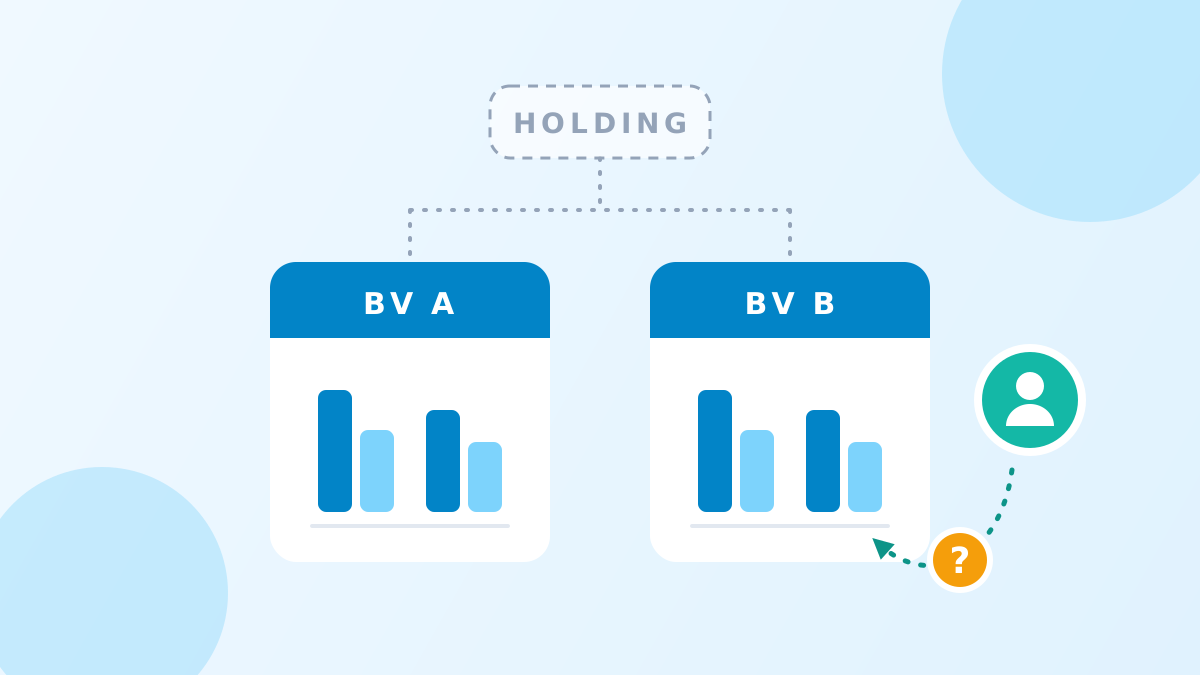
The legal employer is the starting point. When each BV reports separately, when group-level reporting is possible and why agency workers count at the hirer.
Holiday pay, IKB budget, bonus: how the law counts pay and which amount you use for what. With video.

Actively share item g, consult the works council in advance, and explain on request. What the Dutch draft law requires and how to set up an internal route.
See how Payqual supports job evaluation, pay disclosure and the pay gap report with verifiable data.